
Uncategorized
Rise in antique collectors looking for radioactive glassware – Australian Broadcasting Corporation
Dec
Personalise the news and
stay in the know
Emergency
Backstory
Newsletters
中文新闻
BERITA BAHASA INDONESIA
TOK PISIN
By Cameron Simmons
ABC North Qld
Topic:Art History
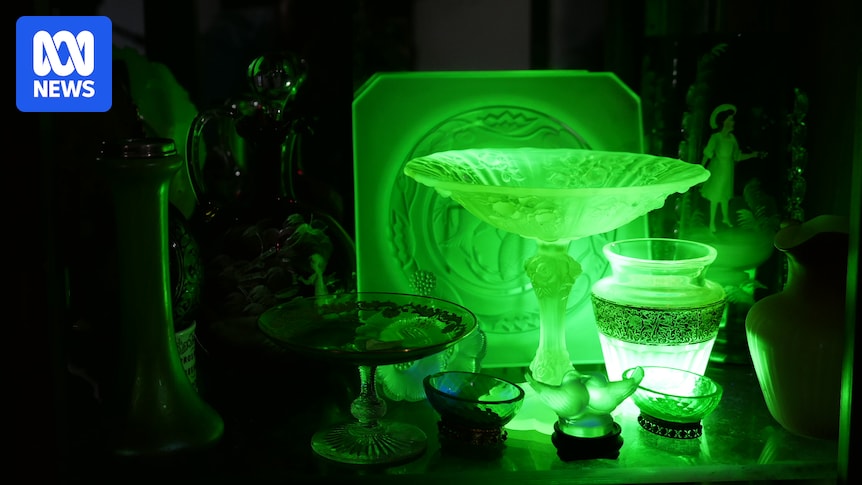
Different elements can also cause ornaments to glow a different colour. (ABC North Qld: Cameron Simmons)
Some ceramics and glass from the late 19th and early 20th centuries were made with uranium mixed in.
They can be found in antiques stores across the country.
A shop owner in north Queensland says demand for glowing products has risen.
Nestled in a north Queensland shop, a collection of uranium glass has made a family nuclear in more ways than one.
The Fleming family have been collecting radioactive trinkets since they started their antique shop in 1970.
"They were made in drinking vessels and mixing bowls and everything you could possibly imagine," Townsville antiques store owner Tristan Fleming said.
Instructions: Use left and right arrow keys to control image transition
Many glass and ceramic trinkets made in the late 19th and early 20th centuries contained uranium to give it a subtle green look.
Under a UV light the subtleness makes way for a bright green glow.
He said it was becoming common to see people coming in and discreetly pointing black lights at ornaments in the hope of seeing a sci-fi radioactive glow.
Tristan Fleming says there has been a rise in young people coming into the shop to collect the glowing glass. (ABC North Qld: Cameron Simmons)
"I am more than happy for you to scan everything in the shop," Mr Fleming said.
"Generally if it is uranium glass, we will have a note on the tag."
Before black lights were easy to buy, distinguishing the difference between uranium and other types of glass was difficult.
Its value has changed over time too.
"Black lights were a fluorescent bulb … that was really the only way," Mr Fleming said.
"When mum and dad started the shop, they said there was basically no difference in price between uranium and depression glass — because it was just green glass.
Mr Fleming said he recommended aspiring collectors use an A365 black light to see a brighter glow.
The glass emits a green glow under a UV light. (ABC North Qld: Cameron Simmons)
The level of radiation of uranium glass is low and considered safe.
Powerhouse Museum senior preventive conservator Kristyn Bullen's role includes looking after all hazardous material in the museum's collections.
"Most of our uranium glass is on open shelving displays … so it is safe for people to be around and handle," Ms Bullen said.
"However, they are radioactive and there is a level of radiation that people are exposed to every time they touch the object."
A nationwide Facebook group has been set up for collectors. (ABC North Qld: Cameron Simmons)
Ms Bullen said the radiation level of most of the items in the collection was less than 10 microsieverts per hour, which was low considering the dosage limit was 1,000 microsieverts per year.
Although generally safe, she advised against physically holding onto a piece for a year straight.
School teacher Veronica Farina is part of a nationwide Facebook group where people show off their uranium glass displays.
She said her collection started by accident when her son bought her a posy vase from an antique shop.
Finding new pieces has become a shared family hobby.
Veronica Farina says her collection started with a gift from her son. (ABC North Qld: Cameron Simmons)
"It becomes kind of addictive."
Mr Fleming said uranium glass production ceased when resources were needed for the Manhattan Project, a secret US government program during World War II to develop the world's first atomic bombs.
"After that it just became more trouble than what it was worth to get the uranium," he said.
Topic:Gambling
Topic:National Security
LIVE
LIVE
Topic:Music
Topic:Diamonds
Topic:Hobbies
Art History
Design
Interior Decorating
Townsville
Topic:Gambling
Topic:National Security
LIVE
LIVE
Topic:Music
BREAKING
Topic:Transport
Topic:Gold
LIVE
We acknowledge Aboriginal and Torres Strait Islander peoples as the First Australians and Traditional Custodians of the lands where we live, learn, and work.
This service may include material from Agence France-Presse (AFP), APTN, Reuters, AAP, CNN and the BBC World Service which is copyright and cannot be reproduced.
AEST = Australian Eastern Standard Time which is 10 hours ahead of GMT (Greenwich Mean Time)
